



On 3 March 2026, Vytautas Magnus University hosted the annual international scientific conference “Culture and Politics of the Francophone World“. The event focused on France’s role in contemporary geopolitics, highlighted the significance of the French language and its global prevalence, and examined various aspects of literature and culture.
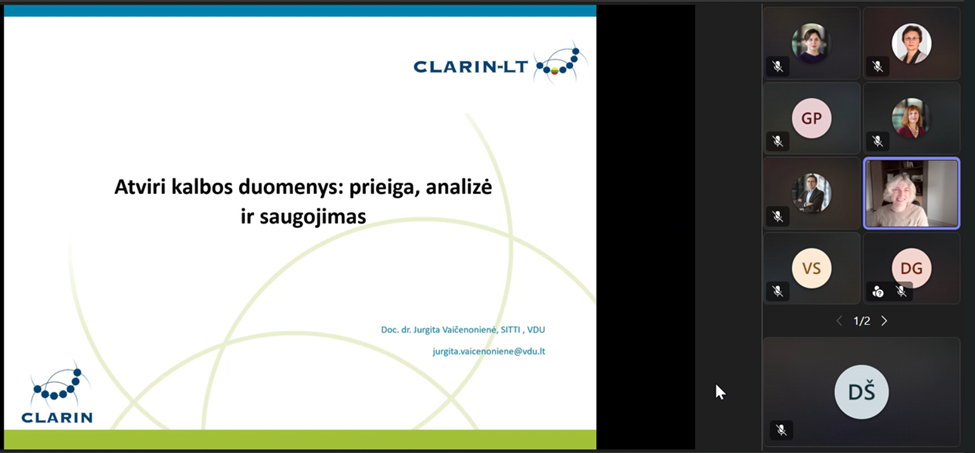
Assoc. Prof. Jurgita Vaičenonienė, a researcher at CLARIN-LT, SITTI, VMU, and CLARIN-LT national coordinator, delivered a presentation at this conference, “Open Language Data: Access, Analysis and Storage”. Participants were introduced to the role of data in current research, the stages of the data life cycle, and the concept of data ecology and its practical implications. The presentation also addressed the benefits of data management plans, key characteristics of metadata, considerations in selecting appropriate licenses, and the principles of FAIR data, highlighting their relevance and importance in modern scholarly practice.
Open science and research infrastructures were introduced, and J. Vaičenonienė offered some perspectives on research infrastructures: “It should be understood that this is not just some servers or technical bases, but a very lively entity that provides advice to researchers on the data they collect, how it can be stored in various repositories, facilitate access to information on training opportunities and conferences, and help researchers identify relevant training resources in their field <…> these services are free and open to researchers from all scientific institutions”.
During the presentation, considerable attention was paid to the CLARIN ERIC infrastructure, including its legal status, activities, quality standards, and the capabilities and advantages of one-stop search with the Virtual Language Observatory. Also, participants were introduced to the history of CLARIN-LT’s establishment and its areas of activity, outlined the types of resources deposited and their origin, highlighted the most popular resources in 2025 in terms of the number of downloads, reviewed the repository’s statistical data (logins, downloads, uploads), and informed that the resource upload guide in Lithuanian can be used to submit materials to the CLARIN-LT repository.

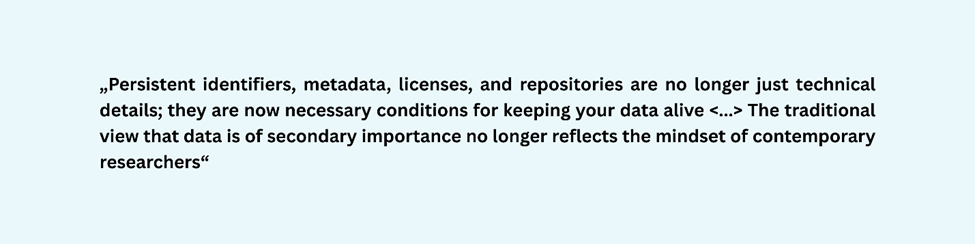
Jurgita Vaičenonienė invited conference participants to use the services and resources provided by the CLARIN-LT consortium and encouraged them to deposit data from completed or ongoing research in the CLARIN-LT repository, thereby enhancing its value and ensuring its long-term preservation, visibility, and accessibility to both national and international academic communities. The researcher emphasised that all resources uploaded to the CLARIN-LT repository are assigned a PID (persistent identifier), which “increases your visibility as researchers” (Jurgita Vaičenonienė).

Leave a Reply
You must be logged in to post a comment.